Rizia grows about 2% a year and stays solvent, but three deadlines are close
Key figures for this quarter. 1950–1953 are campaign estimates set by the Umpire.
Economy since 1950, M mk
National questions
Long tensions set by the Umpire. They are not solved, only managed: decrees move the marker.
Deadlines and risks
| This year | The gas contract with Pales ends; Morella and Lespia follow in 1955 |
| 1955 | The Chamber of Delegates is renewed (turns 5–8) |
| 1957 | The Zille lease to Wehlen ends; Smolak may not return it |
| Now | House Sazon at loyalty 35; below 30 Brenas refuses recruits |
Public objectives
The treasury takes in 2,800 a turn, spends 2,400 and saves 400
Budget points per turn, in hundreds. The top bar is what comes in; the bottom bar is what goes out, and the striped part is what is left for the reserve.
Defence (900) is the largest cost; Economic Strength (1,600) is more than half of all income.
Why each line is what it is
Treasury reserve
GDP, M mk
Public debt, % of GDP
6,000 M mk today; ceiling 80%. Werner's discipline has cut it every year.
Inflation and unemployment, %
How each sector grows, M mk
Construction grows fastest with the rebuilding; mining shrinks as Nelvisar oil runs dry.
What Rizia produces, uses and has left over
Each row on its own scale. Surpluses can be sold in trade deals; deficits must be imported.
State accounts, M mk a year
Revenue 3,600, spending 3,810: a deficit of 210, 1.1% of GDP
Electricity by source, 18 TWh a year
| Installed power | 4,500 MW for an average load of 2,050 MW |
| Coal stations | Porte Drazon and Montaklar; burn mostly imported coal |
| Hydro | The Cardesse dams; the Zpana dam would add more |
| Gas | Topes gas plant, fed by the Esqiris field |
| Oil | Peak and island plants; Caleqabiz |
| Run by | Rizian Electric Company, a state company |
Companies and what they pay the state
Choose a company for its report. A state company hands its profit to the treasury as a dividend, counted under State enterprises (648). A private company pays Corporate tax (432). Gas and gold firms also pay Resource royalties (288).
Rizia sells gas, gold and wine, and buys grain, coal and steel
Every agreement in force, what it moves and the road it takes; what is in storage; and what the economy and the arms industry make. Volumes, prices and routes beyond the handbook are campaign proposals for the Umpire to confirm.
Trade by product, M mk a year
Imports to the left, exports to the right of the centre line
Trade agreements
Each agreement shows who trades with Rizia, which way the goods go and the quarter it ends. Choose one to see its route on the map.
In storage
Stocks held at home against shortages, blockades and war. The bar shows how full each store is.
What the economy makes
What the arms industry makes
Two works are underway; six more and five policies wait for a decision
Infrastructure and industry projects take several turns and cost budget points. Policies and initiatives cost an action. Each turn of a project needs a d10 roll of 6 or more, with the modifiers below.
Works and projects
Medium project 600, large 1,000, paid when the project starts. Status at turn 1 is a campaign proposal.
Policies and initiatives
Economic tracks
Project roll modifiers, d10 needing 6+
Six regions in play, each with its own lord, economy and grievances
Choose a region for its full file: people, output, what it makes, its cities and what they demand, its garrison and its politics.
Output per person by region, mk a year
The mark is the national average of 500 mk
Monarchists and the faithful are content; miners, students and guest workers are not
40.0 million people, median age 25, 62% in cities. 9% are guest workers without the vote. National stability 55.
Population pyramid, millions
Ethnic groups
Religion
Income by fifth of households
Gini 0.46
The King rules by decree, but the houses and the Chamber can make it costly
Press freedom 2 of 10. Intelligence 5 of 10. A decree against a house in its own province needs that house at loyalty 40, or it applies by halves.

Chamber of Delegates
Seats by region
The Chamber cannot pass laws; it approves or disapproves the King's decrees. A disapproval costs 2 stability and 5 loyalty with the elite affected. Parties may not campaign against the monarchy.
Elites, loyalty
The mark sits at 30, where an elite starts to conspire

Royal Council
The people outside the government who shape Rizia, and what each wants
The Royal Council is in Politics; here are the court, houses, army, opposition, business and labour. Their mood follows the elites and groups they lead. Portraits are the official ones from the codex; you can swap any of them for your own image, which stays in your browser.
Counters follow the war-game system: one step is about 750 men, 8 aircraft or one warship group, up to 4 steps a unit. Attack and Defence 1–6, movement in MP. Unit values and stocks are campaign proposals.
Equipment, in units and in depots
Deployment map
Each circle is a base; the number is its steps. Choose one to list its units.
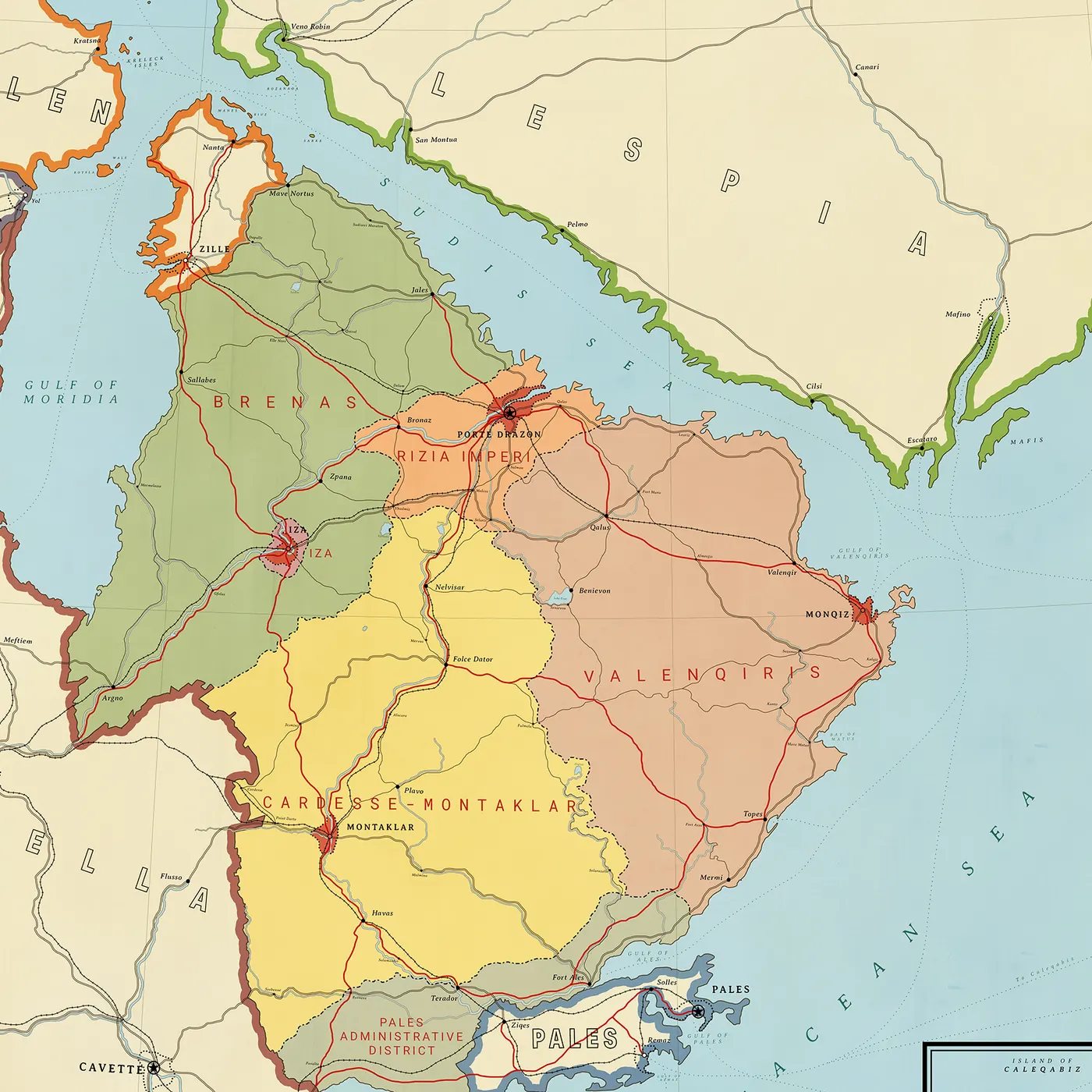
Where the forces are
Every unit by region and base, with the men, aircraft, ships and main weapons it holds. Choose a unit to open its counter.
Order of battle
Choose a counter to read it. The strip shows who it obeys: crimson the Crown, red Toras, blue Azaro, yellow Sazon, grey the police.
What Rizia can recruit
* Only while a foreign supplier is open. Elites only in their home region. Up to 3 new units per city a turn.
Supply and terrain
| Depots | Porte Drazon, Monqiz, Valenqir, Montaklar, Folce Dator, Sallabes, Fort Ales |
| Out of supply | None. Units more than 1 hex from a road or railway to a depot fight at −1 |
| Fuel and ammunition | 30 days of oil and coal; about 30 days of full combat for the guns |
| Terrain | Plain 1 MP; forest 1½; hills and mountains by road, rail or pass; big city +2 to the defender |
Rizia stands with Rumburg, trades with Morella and faces Pales and Wehlen
Relations run from −100, open hostility, to +100, alliance. Scores, trade figures and treaty dates are campaign proposals for the Umpire to confirm.
Relations with every nation
Register of treaties
Treaties and agreements binding the Kingdom of Rizia at the start of 1954
Rules of play
A summary of how Antacea 1954 works from Rizia's side. Where this page and the Umpire's handbook differ, the handbook wins.
1. The turn
Each turn is a quarter of a year; turn 1 is the first quarter of 1954. Rizia is played by three people: the King, the Grand Vizier and the Councillor for War, Security and Foreign Affairs.
During the turn the players agree their decrees, projects, trade proposals, recruitment and unit orders and post them in the nation's Discord channel before the deadline. The Umpire resolves every nation's orders together and publishes the results in the newspaper on Discord. This panel shows the country as it stands at the start of the turn.
- Decree: category, what is done, how, and the expected result.
- Unit order: unit – verb – hex, for example 3rd Infantry Regt – move to – 2623 – if blocked: stop.
- Recruitment: steps, unit type and city.
2. Budget
The budget is counted in points per turn, in hundreds. Income comes from Economic Strength, taxes, GRACE, infrastructure and OMEC; spending goes to the public sector, security and defence. What is left each turn goes into the reserve, and projects and recruitment are paid from it.
- Rizia takes in 2,800 a turn and spends 2,400, so it saves 400.
- A medium project costs 600 and a large one 1,000.
- One extra military step costs 400 to 1,500 depending on the unit. There is no upkeep per unit; the army is paid by the Defence line.
- The state accounts in marks (revenue 3,600 M mk a year) describe the real economy behind those points; companies, taxes and royalties feed them.
3. Economy and projects
Three tracks from 1 to 5 describe the economy. Development measures what Rizia sells (raw goods at 2). Finance measures how exposed it is to market shocks. Market measures how open and balanced its trade is.
A project runs for several turns. Each turn it needs a d10 roll of 6 or more: +2 for extraction and agriculture, −2 for industry and for finance, consumer or high-tech projects, no modifier for state projects and policy nudges. A failed roll loses that turn's progress, not the project.
Policies and initiatives are decrees. They cost an action rather than points, and they move groups, elites and the national questions.
4. Trade and storage
A trade agreement fixes a product, a volume, a price and an end date. Each one follows a route, by pipeline, railway, road or sea; if a place on the route is lost, blockaded or closed by its owner, the flow stops. Agreements are renewed, renegotiated or ended by decree and talks with the other nation.
Stores cover shortages. When an import stops, the store for that product is drawn down first; when it is empty, the shortage reaches industry, the army or the people, as the Umpire rules.
5. Politics
- Houses: Toras, Azaro and Sazon each hold a province and a ducal force. Below 40 a decree against the house in its province applies by halves; below 30 the house acts against the Crown.
- Chamber: approves or disapproves decrees. A disapproval costs 2 stability and 5 loyalty with the elite affected.
- Elites and groups: each decree moves their loyalty and approval. An elite below 30 conspires.
- National questions: long tensions that are never solved, only steered. Decrees move the marker.
6. Military
- One step is about 750 men, 8 aircraft or a group of warships. A unit has up to 4 steps and loses them as it takes losses.
- Attack and Defence go from 1 to 6; movement is in movement points (MP). Plain costs 1 MP, forest 1½; hills and mountains are crossed by road, rail or pass. A big city gives the defender +2.
- Quality: Elite rerolls one failed die; Militia fights worse than Regular.
- Recruitment: up to 3 new units per city a turn. Elite troops only in their home region. Tanks and aircraft need an open foreign supplier.
- Supply: a unit more than 1 hex from a road or railway leading to a depot fights at −1.
- Ducal forces obey the King only while their house is loyal enough.
7. Diplomacy
Each nation has a relation with Rizia from −100 to +100. Treaties, trade, incidents and decrees move it. Treaties are recorded in the register with their terms and end dates; breaking one costs relations with the other party and with anyone watching.